
“There are no foreign lands. It is the traveler only who is foreign”*
Darbast Platform – Mohsen Gallery

Script by Elyas Alavi, Afghan Poet & WriterOpening: May 16, 2014 | 4:00 To 9:00 pm
The exhibition will be continued up to May 23, 2014
Visiting Hours: 04:00 to 08:00 pm
Darbast Platform / Mohsen Gallery
Gallery is closed on Thursdays.
“There are no foreign lands. It is the traveler only who is foreign.”Robert Louis Stevenson, The Silverado Squatters
Leonardo da Vinci wrote, “Art is never finished, only abandoned.” Leonardo of course was contemplating the concept of art from an artist perspective, and thus the second part of the quote seems very apt and relative. Artists virtually every time are forced to abandon their work because they cannot envisage taking any further steps to improve their work, and thus they are said to have left the work. Yet, one must ask: can an artwork ever be finished? Is completion realistic? Life of an artwork depends not on the hands of the artist, but on the gaze of the viewer. The viewer, which in the first instant is the artist, absorbs and engages with the piece, and through his or her interpretation gives significance and meaning to the work. Art is alive only through the audience, and every time new pair of eyes views it, they bring the artwork into present. We like to look for an origin, but with art, a piece is in constant state of rebirth. Art cannot have a conclusion, it can only have existence. Emmanuel Kant argued that a “work (ergon)” cannot exist “without an outline (parergon) for definition”, thus there must be a limit to all that exist in order for it to open up for description and examination. The 20th century French philosopher Derrida, in contradiction to Kant, argued that frames fall into a “liminal” space when it comes to a painting. Yet, more often we see that the artists include the frame as part of the work, and thus there is no outer edge dividing the work from outside, because even the framed painting is framed further by the walls surrounding it, by the building housing and so on.
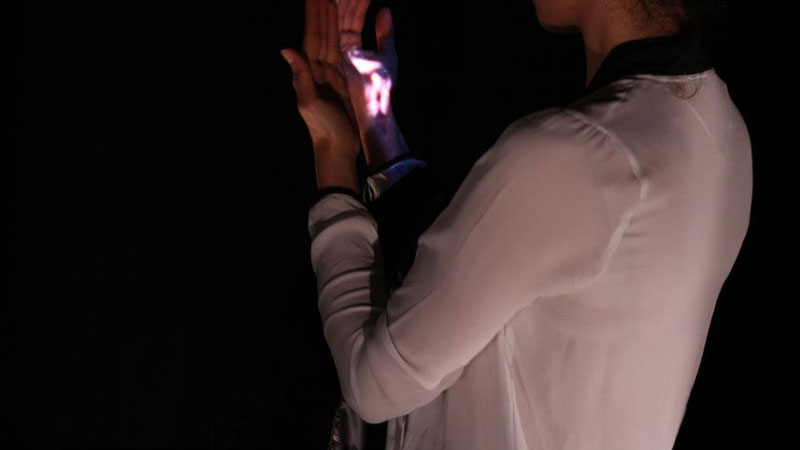
Interactive artists certainly know of this condition, and they seek the audience to play an active role in the life of an artwork. Ila Firouzabadi and Payam Mofidi in their installation, do precisely that. They include the viewers, who seek the images by ritualistically stretching out their open hands. The audience brings the piece into life, and they become part of the work. Limits no longer apply here. There are no edges, just like there are no divisions between people, nationalities and countries. The installation causes all elements to merge into one, creating one existence. One work and you are included in it. The space is essential for the life of the piece, however it is not confining you, because you shall take the experience with you, and through it become more inclusive yourself. If you consider everyone as part of the same world and universe, then what would be the reason for any animosity, prejudice and hatred for your fellow man? Why would you seek to harm anyone or anything? If you experience existence as an all encompassing feeling, then you must allow yourself to be fair and compassionate. You will become the artwork yourself, and there are no ends. Death cannot be found. Only constant rebirth. Only constant equality for all shall be found. Nothing will be foreign to you, and no land shall exclude you. Isn’t that the beauty of life, and that which art has always sought to show us? Taymaz Valley / Art Historian
Cast: Naim Jebelli | Naghmeh Sharifi | Sahar Mofidi | Mahereh Jalilsedighi
Sound: Sam Vafai
Camera: Payam Mofidi, Pirooz Nemati
Special Thanks to: Alborz Arzpeima, Pirooz Nemati, Nima Balazadeh, Parisa Mohit, Sara Reyhani, Ali Panahi