The Killing by Hamed SahihiThe Olive by Samira Eskandarfar
Hamed Sahihi and Samira Eskandarfar will show their latest video works, “The Killing” and “The Olive”
along with some of their older works in Azad Art Gallery on Thursday 8th of Oct, at 5 pm.
Azad Art Gallery, Tehran
No 5 Salmas sq. Golha Sq. Tehran
tel: + 98 21 8800 8676
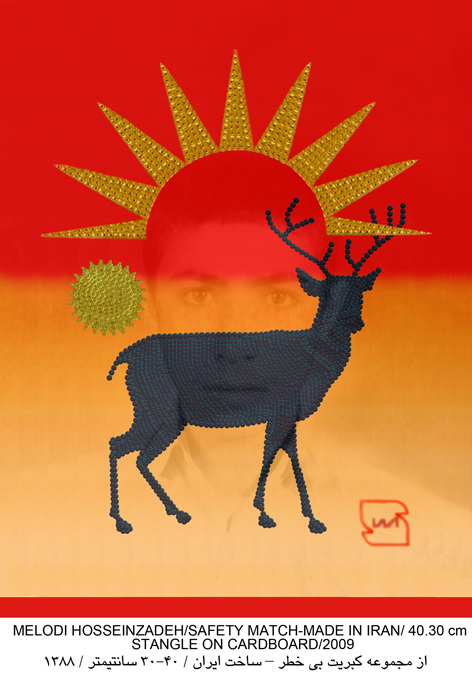
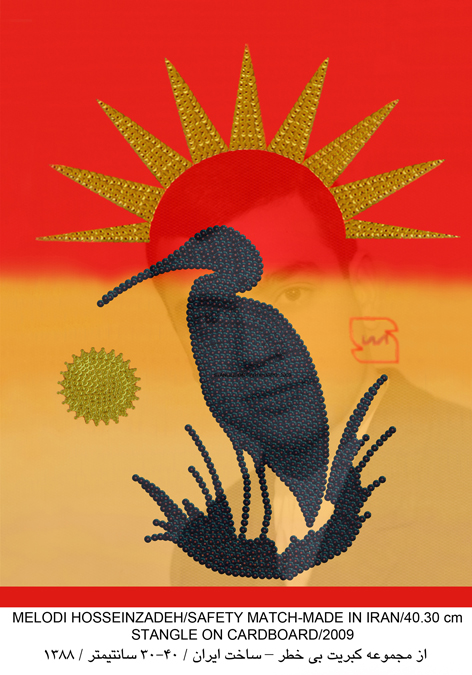
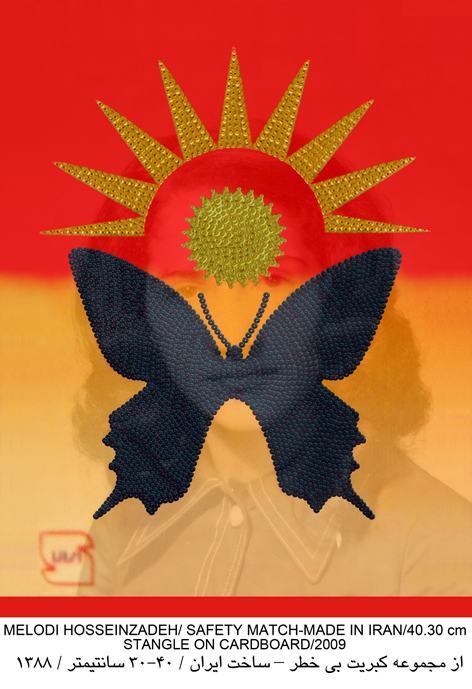
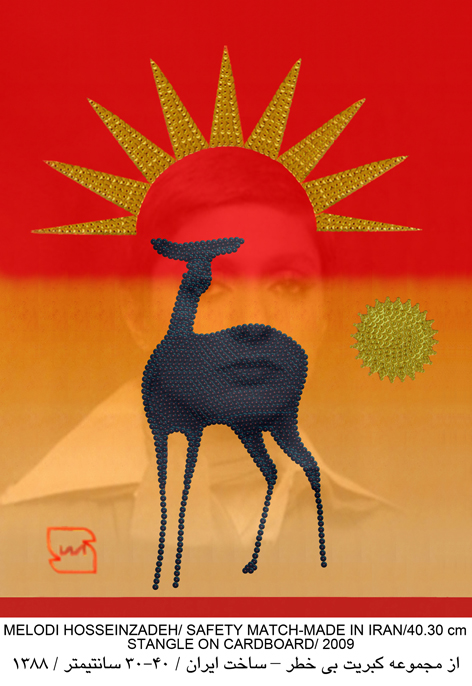
a note on Melodie Hosseinzadeh’s exhibition in Azad Art Gallery, Tehran
by Bavand Behpoor
Tavakkoli Matches Co. annually produces 10 billion matchboxes with 300 workers. Each ordinary Tavakkoli matchbox contains 40 matchsticks. Tavakkoli Matches Co. annually produces 400 billion safety matches. Considering the fact that the company was established in Iran in 1917 at the end of the First World War and has been active for more than 90 years, it has produces thousands of billion safety matchsticks till now.
Tavakkoli Matches Co. can provide each living human being with 60 safety matchsticks per year.
On Wed. 29th July 2009 at 10:37 am Rasekhoon website affiliated with ‘Religious Donations Charity Organization’ reported under the title of ‘We have the Biggest Match Producing Company in the World’ quoting ‘Green Family Magazine’: ‘Today lighters have replaced matches. Large matchstick producing companies each produce certain kind of matches. One produces fantasy matchsticks, the other fireplace matches, etc. But Tavakkoli Matches Co. is the only factory in the world that produces all these products. Mr Tavakkoli says, “Nowadays each matchbox is sold for two dollars while Tavakkoli matches are sold for only 50 cents” and he adds with much pride that, “we are the largest most efficient and influencial producer in the world”.’
On Tavakkoli matchboxes is either a picture of an animal or an advertisement. The animals portrayed on boxes are different in kind and have iconic quality. Tavakkoli matches are a standard of our culture.
On the other side of matchboxes, Tavakkoli Matches Co. congratulates the victory of Islamic revolution on 11th Feb. to the consumers. Since the matches are used throughout the year, it congratulates the victory all yearlong and the consumers think of it when they light the matchsticks.
Matches produced after 1844 are called safety matches, for early matches contained white phosphorus dangerous both to producers and consumers and would afflicted them with phossy jaw or other bone disorders. At that time, the amount of white phosphorus in one box was enough for killing a human being.
Tavakkoli matches have been used throughout Iranian history for firing Reza Shah’s cannons, lighting Molotov cocktails, burning cinema screens, lighting cigarettes of soldiers, drug addicts and those sentenced to death, for setting oneself on fire, for lighting fire in forests, for setting cats on fire, for allowing kids entertain themselves during long afternoons, for lighting alcoholic lamps or setting garbage cans on fire. As such, it is no doubt the symbol of our national identity. Matchsticks are made of pinewood and their so-called sulfur is made of a mixture of 12 chemical elements attached to the stick with animal silicone.
The last point you need to know in order to enjoy the exhibition is some acquaintance with Vogue magazine and the art of illumination.
Curated By Vahid Sharifian
A group photography and painting exhibition by Afshin Chizari, Hadi Fallah-pisheh, Siavash Naghshbandi, Mohammadreza Mirzaei, Ali Zanjani, Hoda Kashiha and Shabahang Tayyari.
“The commonalities of the artists featured here, reference a period and situation from which they have taken influence. they are all 22 or 23 years old, they have all experienced childhood –the period in which their personalities took shape– in the post-war years, they have a newer attitude and ideology compared to my generation, the period of their youth took place during the second half of the 1990’s and their art is inspired from the events and conditions which formed during this time and took shape in the first decade of the 21st century.
These artists experienced the aftermath of war and not war itself. As such their work is more introversive than the frankness and violent absoluteness of the war years and Iran of the 1980’s.”
Vahid Sharifian, from catalog of the exhibition
Assar Art Gallery
16 Barforoushan Alley, Iranshahr St. Karimkhan Zand Str. 15836 Tehran – Iran
Tel: +98 21 88 32 66 89 www.assarartgallery.com
Persianissimo; An Iranian Contemporary Poster Exhibition
An Iranian Contemporary Poster Exhibition
On the Occasion of the 16th Colorado International Invitational Poster Exhibition 2009
Persianissimo; An Iranian Contemporary Poster Exhibition
Curated by Majid Abbasi, 28 posters by 28 Iranian designers Fort Collins Museum of Contemporary Art
September 27 – December 22, 2009
Opening Reception, September 30, 7 – 9 p.m.
An Exhibition of Contemporary Iranian Video Art in London: Henry Moore Gallery, Royal College of Art, London,
15-17th October 2009
Admission Free
Opening times 10am – 8pm
Magic of Persia is presenting a pioneering and unique exhibition of video work by 14 Iranian artists, in the RCA’s Henry Moore Gallery. Curated by Dr Sami Azar, former director of the Tehran Museum of Contemporary Art, the show is the first time that contemporary Iranian video artists have been shown on such a scale in London. Established names such as Farideh Lashai and Avish Khebrezadeh, will be displayed alongside younger video artists, providing a great opportunity to view the diversity of current Iranian video art.
Hilger Brot Kunsthalle presents The Promise of Loss.
The Promise of Loss.
A Contemporary Index of Iran.
Curator: Shaheen Merali
Living as we all do in an imperfect world, where the remainders of the past fall away or return to haunt our creative contemporaries, the exhibition is a consolidation of many dashed hopes, a desire to build a shrine as well as to plant trees in the campus condemned to destruction. The artists enable both a reading of the situation and encouragement to cross the distance where the bitterness of loss reigns within the national moral.
The exhibition The Promise of Loss is organized to mine the huge ground of Iran. The connection of expertise to experience, the rhythm of its measures and the constancy of the artistic gaze into its shadows have made listening to the artists’ interpretations more urgent.
Mandana Moghaddam’s installation Sara’s Paradise (2009) is an ode to the time-honored place in the cemetery of Behesht e Zahra, Tehran, where the fate of the martyrs from the Iraq-Iran war that claimed over 800,000 young lives are commemorated. The place, as seen in the installation, is a gory fountain of red water continuously bleeding into the world. The source of the blood is the martyrs and their families who encouraged holy participation to the bitter end, lured by a promise of a place in paradise.
The exhibition will be curated in five sections:
a) Beyond Iran and near Tehran: Peyman Hooshmandzadeh and Mandana Moghaddam.
b) Graphic, unfolding tributaries: Parastou Forouhar, Sara Rahbar and Neda Razavipour.
c) Responses to legacies: Samira Abbassy, Babak Golkar, Amin Nourani, Behrang Samadzadegan and Jinoos Taghizadeh.
d) The main-melancholia: Iman Afsarian, Shahram Entekhabi, Abbas Kowsari and Rozita Sharafjahan.
e) Re-imaging the revolution: Masoumeh Bakhtiyari, Asgar/Gabriel, Shadi Ghadirian and Leila Pazooki. (Text by Shaheen Merali).